Solo Rehearsal or Paired Practice? Match the Format to the Skill
Solo rehearsal or paired practice? Match practice to the skill learners need, with a clear choice of format and a worked example for session planning.
Choose solo rehearsal or paired practice by asking what the learner must do next: produce an answer independently, or respond to another person. That choice matters because a voice recorder can reveal a muddled explanation, but it cannot ask a follow-up question.
Start with the task
Describe the performance as something another person could hear or see. “Understand the handover” gives no clear practice target; “tell a colleague the current status, next action and unresolved issue” does.
Then ask whether the task changes in response to someone else. Drafting an update, recalling a sequence or explaining a decision can often begin alone. Interviewing, negotiation and responding to a concern depend on another person’s words or behaviour.
Keep the target small enough to repeat. A learner preparing a customer conversation might practise the opening question first, rather than trying to rehearse the entire exchange at once. Like choosing a tool for a job, the useful format depends on what the task requires.
Choose the format
Solo rehearsal suits work where the learner can make and inspect an attempt without a partner. They might write a short email, work through a calculation, speak an explanation into a phone recorder or arrange prompt cards into a sequence. A model or task-specific rubric can help them notice what is present and what needs another pass.
Paired practice suits work shaped by an exchange: listening, turn-taking, questioning, negotiation or adjustment. Give each person a role and a clear prompt. If both need to practise the same skill, swap roles; if the workplace task assigns distinct responsibilities, keep those roles distinct.
Some skills call for both formats. A learner can first organise an explanation alone, then try it with a partner who asks a relevant question. Solo preparation supports a clear starting point; the exchange reveals whether the explanation can adapt.
Make the choice
Use these checks to decide what learners need and what they should do next:
- Check whether the learner can produce the target without another person; if yes, begin with solo rehearsal, but if no, use a partner who can supply the missing prompt or response.
- Check whether the skill depends on listening or timing; if yes, choose paired practice, but if no, keep the attempt solo unless interaction is part of the intended performance.
- Check whether a private draft or recording exposes the evidence you need; if yes, let the learner inspect it alone, but if no, arrange an observer or partner to make the missing behaviour visible.
- Check whether learners have enough information to begin; if yes, start the task, but if no, add a concise prompt or model before practice rather than leaving them to guess.
- Check whether both partners need to perform the same role; if yes, plan a role swap, but if no, retain the distinct roles and make each person’s task explicit.
- Check whether the scenario invites personal disclosure; if yes, replace it with a fictional workplace situation, but if no, use the ordinary case and let learners decline any prompt that feels uncomfortable.
Set clear conditions
State the task, the behaviour to notice and how the attempt will be reviewed. “Ask one open question, listen without interrupting, then summarise the concern” gives a pair something specific to observe. “Be supportive” does not.
For solo work, provide the prompt and a way to inspect the result. For an explanation, a short checklist might ask whether it names the decision, gives a reason and states the next action. For paired work, say whether the observer should take notes, pause the exchange or wait until it ends.
Keep the scenario ordinary and bounded. If the subject could touch a sensitive workplace issue, use a fictional case and offer a neutral alternative. Learners should practise the skill, not feel pressed to reveal private experience.
Review the attempt
Keep the review tied to the chosen performance. “You asked what had changed before suggesting a fix” identifies an action the learner can repeat; “You were good” does not show what worked.
Invite the learner to choose one adjustment, then repeat the task. A second attempt makes the format useful: solo learners can revise a draft or spoken run-through, while pairs can try the exchange again with the agreed change.
Which format fits?
Can you rehearse a conversation alone?
Yes, if the immediate aim is to organise wording, recall key information or reduce hesitation. Use a partner as well when the skill includes adapting to an unexpected question or response.
When is paired practice necessary?
Choose a partner when the performance depends on hearing and responding to another person’s words, as in an interview or a conversation about a misunderstanding. Define the roles and the behaviour to notice so the exchange stays purposeful.
Should learners switch roles?
Switch when both learners need to practise the same performance or when trying the other position clarifies the exchange. Keep roles fixed when the task assigns different responsibilities and only one role carries the target skill.
How can role-play feel less awkward?
Use a brief, familiar situation with enough detail to begin, then name the skill being practised. Offer a neutral scenario or a way to pass if the subject feels too personal.
Worked practice choice
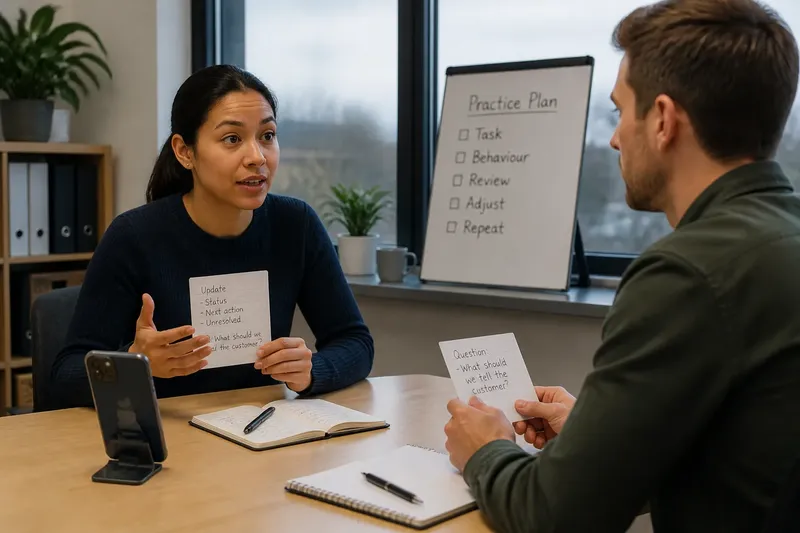
Imagine a trainer planning practice for a delayed-delivery update. The starting task is to tell a colleague the status, the next action and what remains unresolved; the trainer also wants learners to handle a question about what to tell the customer.
First, the trainer gives each learner that three-part prompt and asks for a spoken update alone. The learner records it on a phone and checks whether all three points are present. Suppose the recording includes the status and unresolved issue but omits the next action: the learner adds that action and records the update again.
Next, the trainer pairs learners. One gives the update; the other asks, “What should we tell the customer?” The learner answers, then they switch roles because both are practising the update. The decision is clear: solo rehearsal helped organise the message, but paired practice was needed to rehearse the response. The observable result to look for is an update that includes the next action and can continue after the question.
Carry practice forward
Connect the chosen format to a cue in the learner’s work. They might keep a reminder beside the handover template or decide to use a particular opening question in the next customer conversation.
For solo rehearsal or paired practice, make the choice from the work itself: can one person produce the evidence, or does the skill depend on an exchange? If both are true, prepare alone and then practise with a partner. That division gives each format a distinct job instead of asking either one to do everything.