Guided Observation for Workplace Skills
Guided observation for workplace skills helps learners notice the cues behind skilled decisions, discuss what they see and prepare for a supported first attempt.
Guided observation for workplace skills turns a demonstration into a chance to notice how decisions are made. Before a new colleague watches someone prepare a customer order, give them one specific cue to track: how the practitioner confirms an unclear detail before entering it.
Without that focus, a learner may see fluent movement but miss the judgement behind it. A useful observation routine links three things: what the practitioner notices, what they do next and what happens as a result. It is less like watching a whole room and more like pointing a torch at one important corner.
Choose a visible focus
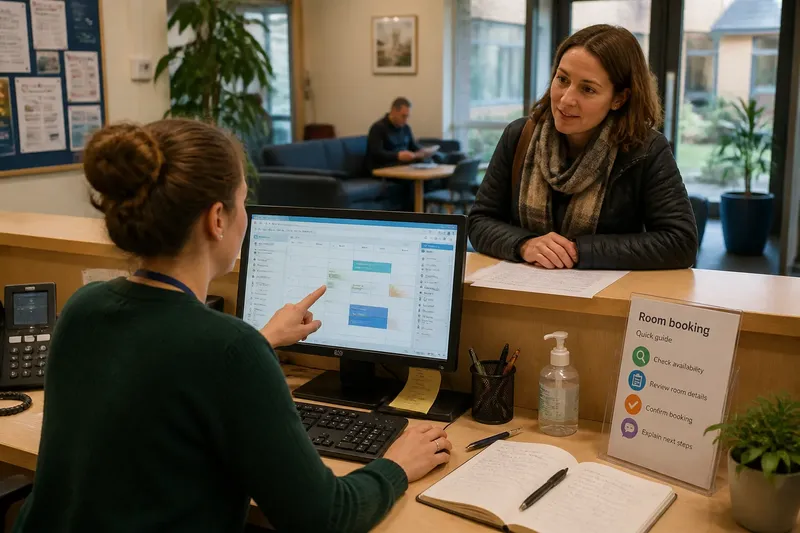
Start with a task that has actions the learner can see and decisions the practitioner can explain. Choose one focus, such as how a baker checks dough before shaping it or how a host confirms access needs before arranging a meeting room. Avoid asking someone to track every movement at once.
Agree on the focus with the practitioner before the demonstration. A prompt such as “Notice what makes you pause before choosing the next action” directs attention towards a decision, rather than inviting the learner to copy a sequence without understanding it.
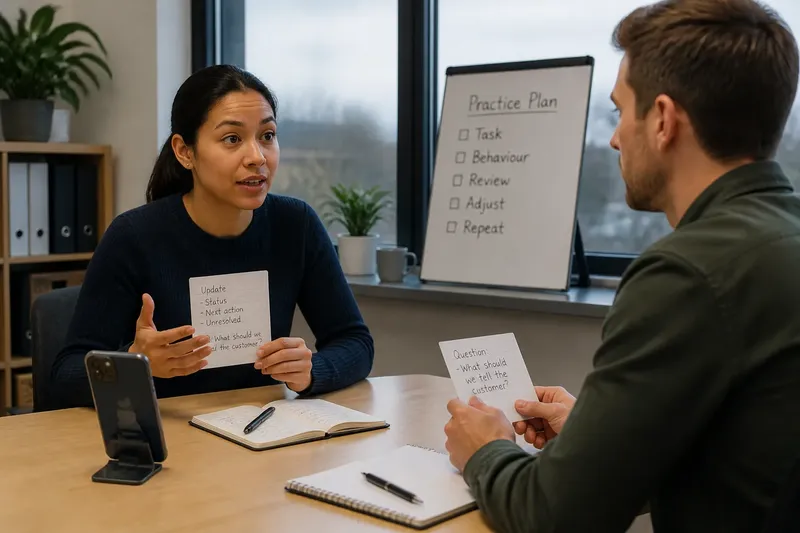
Prepare three short note prompts:
- Observation: What cue, question or change did the learner see? If the note names a visible detail, discuss what it may mean; if it records a guess about motive, ask the learner to separate inference from observation.
- Action: What did the practitioner do after noticing the cue? If the action is clear, compare it with the learner’s expectation; if it is unclear, ask the practitioner to repeat or describe that moment.
- Result: What changed immediately afterwards? If the result helps explain the action, connect the two; if no result is visible, identify what further information would clarify the decision.
- Uncertainty: What part remains hard to explain? If the practitioner can clarify it, add the explanation to the notes; if not, mark it as a question for an experienced colleague.
- Variation: What changed between this instance and another? If the cue changed, discuss how the response adapted; if the underlying decision stayed stable, note what remained consistent.
- Boundary: Where should the learner pause and ask for help? If the limit is clear, agree how to signal for guidance; if it is uncertain, keep the learner observing until the practitioner clarifies the boundary.
Keep the notes brief. A few words, arrows or a small sketch can be more useful than a long account that pulls attention away from the work.
Structure the demonstration
Ask the practitioner to show the task at a pace that lets the learner see its important choices. They need not narrate every movement. Instead, they can pause at a decision point and name the cue that shaped their next action.
Before the task, tell the learner what to watch for and why. During it, allow quiet time for observation. Afterwards, let the learner write their account before hearing the practitioner’s explanation. Comparing the two can reveal what the learner noticed and what still needs to be made visible.
Useful prompts stay close to the action: “What made you stop there?”, “Which detail changed your next move?” and “What would you check before continuing?” If the practitioner finds a decision difficult to explain, they can point to the cue, compare harmless alternatives or repeat the moment with practice materials.
Move from watching to joining
Observation does not need to follow a fixed timetable. Keep the focus on a task until the learner can describe its relevant cues and explain where they would seek help. Then invite a small contribution that suits the learner’s role and the consequences of an error.
For example, a learner might confirm a request or prepare a non-critical part of a setup while the practitioner remains available. Agree on a clear pause point before anything consequential. If the learner cannot yet identify when to stop, continue observing and discuss that boundary before handing over a task segment.
After the learner participates, return to observation. Ask what they noticed during their own attempt and how it compared with the practitioner’s choices. The aim is not a smooth imitation; it is a growing ability to notice relevant cues and respond within appropriate limits.
Worked meeting-room example
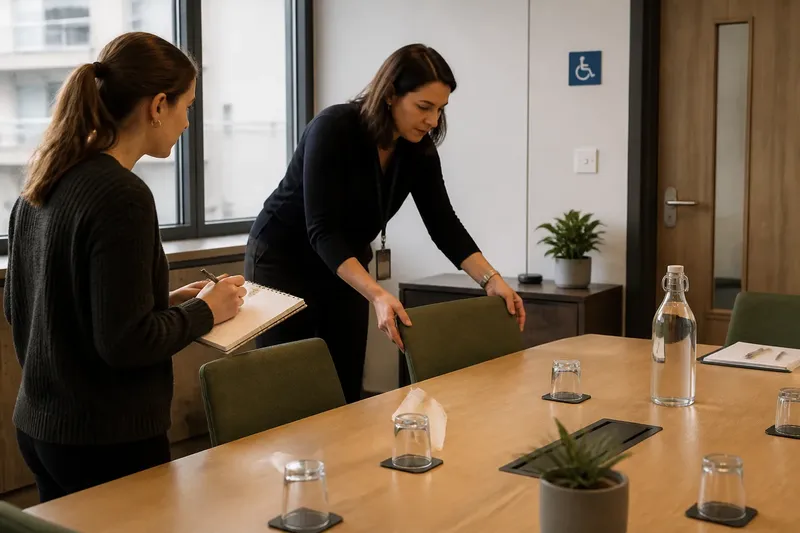
Imagine a new colleague learning to prepare a meeting room for a visiting client. The starting information is a booking that lists the room, the client’s arrival and a request for step-free access. The experienced host will demonstrate the preparation; the learner will focus on how booking details affect the room layout.
First, the host checks the booking and asks the organiser to confirm the access request. The learner writes down the visible cue—the access note—and the action—checking it before moving furniture. Next, the host moves a table to leave a clear route. The learner records that the layout changed in response to the confirmed request, rather than assuming the table was moved for appearance.
During the discussion, the learner says they would also check whether the requested presentation equipment is available. The host explains that the booking does not confirm that detail, so they should ask rather than assume. The resulting decision is clear: the learner can prepare the room’s agreed layout, but should consult the host about unconfirmed equipment. On the next suitable occasion, the learner prepares that part while the host remains present.
Guided observation questions?
How long should a learner observe?
Continue while the learner can attend to the chosen focus and discuss what they noticed. If attention fades or the task offers no useful decision point, pause and arrange a shorter or clearer demonstration.
Should the practitioner explain every move?
No. Continuous commentary can compete with what the learner needs to see. Ask the practitioner to explain significant cues and choices, then leave room for the learner to form an account.
What if the task changes each time?
Focus on recurring decisions rather than expecting an identical sequence. If a variation changes the relevant cue, discuss how the response should change; if the situation is too unusual to interpret confidently, consult an experienced colleague.
When should the learner take part?
Offer a bounded contribution when the learner can describe the relevant cues, understands when to pause and knows whom to ask for guidance. If any of those points is unclear, keep the learner observing and resolve the uncertainty first.
Keep the focus useful
Good guided observation for workplace skills makes attention specific without reducing the task to a script. Choose one visible cue, connect it to a decision and leave time to compare the learner’s account with the practitioner’s reasoning.
End each observation by agreeing what the learner should notice next. It might be a related cue, a variation in the task or a boundary that still needs explaining. That small choice gives the next demonstration a purpose and helps the learner see more than the movement: they begin to recognise what skilled work is responding to.